Euthymius Zigabenus’ Commentary on the Epistles has been published only once in history, by Nikiforos Kalogeras in 1887, and I want to honour him for the work he did in making his edition of the commentary available in print, without which my current project would be almost impossible.
Contents
Preface
Biography
The 3 Oil Paintings
–Painting from the Φιλεκπαιδευτική Εταιρεία
–Painting from the Rizarios Ecclesiastical School
–Painting from the University of Athens
Preface
To read about how I learned about Nikiforos Kalogeras, please go here.
Biography
The untimely death of the former Archbishop of Patras and Ileia, Nikiforos Kalogeras, robbed our Church of one of her most modest men and robbed both our ecclesiastic philology and the philology outside the Church of one of the fruitful and original authors. In his warm zeal for the Church, in his inextinguishable yearning for the glory of the nation and its Church, in his excellent services which he offered to the Church, in his wise authorship, through which he acquired for himself a worldwide reputation, in his purely Greek-mannered character which he imprinted in the works of his thought, in beloved moderation and the other Christian virtues, the late hierarch surpassed all of the clerics of the last fifty years. The loss suffered by the Church and by learning is incalculable, that such a man, exhausted by a withering illness for years, was not able to use his great experience in ecclesiastical things and his wide-ranging knowledge for the good of the Church and science. Death rather increased this loss further, since it destroyed his precious strength, which indeed, according to nature, owed him so that he could produce for decades still to come. Those of our community who toil for religious and scientific advancement will greatly mourn the loss of such a hierarch, and our Association more generally also has especial reasons to mourn this most precious man. The late one was an honorary member of the Association for Promoting Education and Learning and a benefactor. He used to love and greatly honour our Association, he would adorn its feasts and bless its works, he would be present at its public lectures and interviews. He was a most dear person. He always provided courage and a center to the works of love and knowledge, with which the Association busied itself. The Association will never forget his sweet form, his modest and sacredly solemn posture, his sweet words, and his encouragements. His appearance in the Association is likened to a descent from above of one of the great illuminators of Asia Minor: Basil the Great, Gregory the Theologian, or Gregory of Nyssa. The presence of the most venerable hierarch would arouse in the souls of the members such reverence, such holy mental images. For this reason, his death has appeared to be very bitter to our Association. The Board of Directors interrupted the activities of the Association immediately because of the baneful tidings, and it sent a letter of condolence, through the president, to his family. At the first general meeting of the Association after his death, the president, because he was moved exceedingly, exalted the virtues of the late one: his great struggles on behalf of the Church and science and his enviable reputation in the Church and in science; he expressed with words which expounded the spiritual misery of his listeners and the deep sorrow of the Association because of the untimely death of the most precious hierarch, who for decades was still able to offer his soul, filled with divine fire, and his wise mind in service of the Church and science. The president put a seal on the just praise of the departed hierarch after calling everyone to stand in his honour.
Waiting to write carefully concerning the scientific and ecclesiastical activity of Kalogeras, we readily record here his biography, written as a labour of love by his worthy nephew Ioannis Kalogeras[1], head of the school of Spetses.
Biography of Nikiforos Kalogeras, Archbishop of Patras and Ileia.
Nikiforos Kalogeras was born in the year of our Lord 1835, June 24th, by pious parents on the heroine of the islands, Spetses. The man was thin in form, sinewy, tall in height, yet his forehead was large and straight, and his eyes were large and energetic, in which his acute perception and his clear-sightedness of his soul were stamped. And his nose was ordinary, and his lips were outlined by an ever-virgin smile. To sum up, on his whole face was poured out the grace that unwillingly seizes the one who converses with him. He was noble and good with respect to his soul, ambitiously generous, industrious, affable, courteous, ever sagacious, eloquent, persuasive, charming in intercourse, taking a firm stand in his confidence and not being led or borne by things that have happened, as he showed in his whole way of life. This one, having been taught the first and most fruitful lessons of morality and reverence by his mother Adamantia, who was of the most pious and sensible women of the island, and having been taught in the schools of his own fatherland (as many lessons as he was able to be taught) and having been trained sufficiently concerning the ecclesiastical letters both from repeatedly going to the churches and from the reading and study of the holy services, already by his 16th year, out of love for higher instruction and ecclesiastic education, marching off, he departed for the holy mountain of Athos.
In this year (1851), a century of the Athonite Academy was almost over, which the brightest of the lights in the Greek horizon that came to light since the Fall, the most far-famed hierarch Eugenios Voulgaris, made bright and founded in the year 1749,[2] having been invited for this purpose from Kozani, where he was the head of the school. The cessation of the academy proved to be unobserved by the Greeks, as though it were not providing benefit. But during this six-year period, a star of such greatness was reaching its zenith, and the shining of the star did not cease, even after a passage of so much time, still illuminating it (the academy) through some faint rays. The young worshipper from Spetses, having been tonsured a monk in the holy monastery of Xenophontos, and hearing the name “Nikiforos” instead of “Nicholas”, according to his good fortune, entered after not much time as a student into the school which was maintained then by the expenditure of the charitable monasteries of Athos, in which school he found teachers who were deemed students both of direct and indirect homilies of Eugenios. As was reasonable, the system of education of these men spoke to the spirit of that divinely-sweet priest, which was suitable to a great degree for rekindling the inspired love for the Muses. Therefore, the youth, having been lifted up by this spirit of the divinely-sweet man, devoted himself completely with a thirst that was not by chance and he became admired among his classmates. With this continuous and resolute study, he set firmly the foundations of his later-on ability in teaching and in written composition.
Kalogeras, having completed the whole five-year term at the School, with which this story is concerned, having already been ordained a deacon, he came to reside in Athens in the year 1857, where, after completing his high school education in the Rizarios School, he listened to those who taught the theological and philosophical classes for two years at the University. Then, after moving to Cairo in August of 1860, and after becoming the head of the Patriarchal School, at the same time and with a lot of toil and frugality, having collected the necessary money for the completion of his studies, he departed for Athens, where he was ordained a priest. He then departed in 1863 to the wise Germany, longing for higher education. He busied himself there for 4 entire years, going back and forth between various universities of that country which was reared by the Muses. Having been proclaimed a Doctor of Philosophy at the University of Leipzig in 1867 and, publishing in Budapest that same year the Alexandrian theological and philosophical works of his study, he returned to Greece, where, in January of 1868, he was accepted as a teacher of patrology in the Theological School of the University and he exclaimed that excellent speech on the feast of the Three Hierarchs, because of which the Senate, on that very day, through the then rector Theodore Orphanidis, published a laudatory letter to Nikiforos, which remained unpublished until the end of the life of the one who received it because of modesty. It is presented here: “With emotional sorrow of the soul we listened to the speech which you recited today, according to the command of the Academic Senate, from the pulpit of the Church, during the annual rite of the Ethnic University. The University and all the learned listeners, during this rite, discerned in you natural and newly acquired gifts from the recited speech. We think, from our holier duties towards the just praise imparted to you, that you should set your attention on the development of these natural and newly acquired superior qualities and that we should exhort you to not stop, because we exercise and perfect you for both the good repute of the Church and the boast of the University, of which you fortunately comprise a portion today.” This letter, which is exact in language, persuades us that the ingenious poet, who was used in that circumstance, entered, by his sharp-wittedness, into the soul of the man through her hidden windows and concluded from the recited speech that such a scientific arena was smiling sweetly at the young man and unknown teacher. In August of that year, he was declared a sessional professor, accepting the teaching of Christian archaeology, which unfortunately was left incomplete in manuscripts, together with the course on patrology. In October, the Holy Synod, having clear evidence of his sacredly-beseeming way of life and the purity of his life, together with his undefiled knowledge concerning theology, reported in its formal letter: “It (the synod) decreed to honour him to the Ecclesiastical honour of Archimandrite.”
In 1870, he was hired by the then wise professor, Konstantinos Kontogonos, as a co-worker and co-publisher of the remarkable periodical “Evangelical Herald.” In 1871, by command of the Church of Greece, he gave that exceptional speech, which will continue to be exceptional because of both his high thoughts and his rhetorical skill, in the Metropolitan church on the occasion of the transfer of the relics from Odessa of the first-martyr of the Greek regeneration, Patriarch Gregory V. In that year, during the disputes that were led round to an acute point by the wickedness of the Bulgarians and that were throwing the Church into confusion, he (Kalogeras) was sent by the Greek government to Constantinople in order to closely follow their thorny course from a close proximity. His dispatch lasted four months. And the tidings which he brought back, being most clear and exceedingly exact, which were communicated to the leaders of the then political parties, (the tidings) so awakened their interest, that thereafter they closely followed the matter with a most careful eye. When that year ended, when Epameinondas Deligeorgis was the Prime Minister in 1872, because the Bulgarians crazedly fanned the flames of that blazing matter, Kalogeras was again sent to Constantinople in order to help out the chosen men of the Clergy with the proclamation of the schism and, in this way, to put an end to the continuous and unjust war of the Bulgarians against the Church, which indeed happened. Indescribably and inexpressible were the pains with which Kalogeras ached when he wrote and operated concerning this matter, as the letters which will be published after not much time from Constantinople to Prime Minister Deligeorgis will bear witness to, which are found among his manuscripts. With these things being this way, he was justly considered as the chief worker of the saving of the schism for our nation, which was placed as a fortification from the activity of the Bulgarians on the other side of Thrace and Macedonia. He saved the Greek population of these regions from becoming Bulgarians.
In 1873, after being declared the First Secretary of the Holy Synod, he did not stop teaching as honoury professor at the University. After withdrawing from this position in 1876 because of growing dispute in the Synod, he was again immediately declared sessional professor, and after a period of three years (1879) full professor, and he remained in this position until he was ordained as Archbishop (1883). In the summer of that year, 1879, he went abroad to Italy, in order to visit as many public and private libraries there that he could, there where there were texts for many reasons (for the majority of Greek manuscripts were banished there by the educated Greeks before the Fall of Constantinople and afterwards), suspecting that the manuscripts of Euthymios Zigabenos, which he earnestly sought for some time, were there, because of which manuscripts he visited beforehand all the libraries of the Monasteries on Holy Mount Athos. After futile ventures at other libraries in other Italian cities, he arrived at Rome, where, finding the Vatican Library closed, he devoted himself to study then at the other libraries of that city, and, especially at the Monastery of the Dominicans that is beside the Pantheon, in which the so-called Casanatense Library has been constructed. After many questions and investigations, he discovered in that library the intensely sought-after manuscripts, which, though he was unable to copy because the time of his sabbatical was coming to an end, and because he was urged to return home for the sake of teaching at the University, he made copies of their contents through photographs.
At the same time as the annexation of the new provinces in 1881, as he was going around Thessaly, he observed that there were manuscripts in absolute disarray in very wet rooms in different monasteries, which were both getting increasingly damaged day by day and were diminishing in number. After returning to Athens, he related this to the king and to the Prime Minister, Trikoupis, having decided at the same time that the preservation of these thing by the state, in order for its success to be achieved, had to not be requested by the encyclicals of the ministers to the abbots and the heads of the monasteries, because such an act would have as a consequence not the preservation, but the hiding away and the disappearance of the majority of and of the most important manuscripts, as happened in the rest of the monasteries of the State during the Regency of King Otto. The direct and sudden reception was decided upon by the authority, and Kalogeras was sent, in 1882, as its representative for this. And, in this way, they collected with great toil and, what is more, with threats, approximately 800 manuscripts of varying material and age and worth, which, after being added to the almost uncountable collection of the University, they rendered the department of the Nation Library worthy of both esteem and word. It is not judged as a digression to be added here a passage from the calendar of Kalogeras’ trip to Russia (1889), which passage is appropriate for the topic of discussion. “… In that department (of the National Library in St. Petersburg), I saw most manuscripts which the Russian archimandrite Porphyrios, whom the Russian government later honoured with the rank of Bishop, banished from the monasteries of Meteora 30 years ago. I pondered then the pitied inhabitants of Kalambaka, who, having been armed to the teeth (as if they were about to take to the field against some non-existent Turks) and exercising their voices as if enraged, surrounded the Monastery of the Dormition of the Theotokos at Meteora, where I was found and where they threatened me, if I were to take the manuscripts and transfer them to the National Library in Athens in accordance with the purpose of the Greek government. Among the cries, I discerned also some voices saying that they want the manuscripts near them so that their children might be enlightened, since Athens was very far away. Let them send their children now to St. Petersburg, which is near to them, not in order for them to be enlightened, but to open their eyes…”
In 1883, he published the “Pastoral,” an original written work, which continues to be a most precious pendant to the clergy of the Eastern Church. John, the bishop of Salisbury, having become an acquaintance of Kalogeras at the conference of Old-Catholics that was organized in Lucerne, Switzerland, in a letter to him (Kalogeras) concerning the “Pastoral”, writes the following: “Having read many things of your ‘Pastoral’ with utmost benefit, I wanted to provide it to our priests through the English language, (the opportunity is not permitted; for I am hard-pressed by the long and painful disease of my most dear wife, who lies near death) for it is beneficial for demonstrating that the thought of the Greek Church agrees in most ways with our Church.” In that same year, by the persistent demand of the king and the government, he received the archbishopric of Patras and, on June 7th, the Monday of the Holy Spirit, he was ordained archbishop of this district at the Rizarios School, even if he knew that the spirit of both the time and the city were against him. But after a period of two years, in August of 1885, his application of resignation from this archbishopric due to health reason, which was submitted months before, was accepted, just as his fame spread abroad. The written exchanges, which will perhaps be published with the passing of time, pertaining to the submission and reception of his resignation between him and the Holy Synod during the period of time that had slipped away, bear witness to the envy at his zenith of his most reverend colleagues in Christ. But this must also be added, that if both the cabinet and the Holy Synod were to deny accepting his resignation, he would have to depart from his beloved fatherland, as he wrote to the king, since it is first for ethical reasons, and second for reasons of bodily health that subjected him to submit the resignation from the archbishopric to the Holy Synod. From then on, he cleaved to the quiet life and gave himself over to study. A fruit of this was the publication in 1887 of the two volume Commentary of Euthymios Zigabenos on the Epistles of the Apostle Paul and of the Universal Epistles. Kalogeras was the first, as we have already said, to uncover this radiant work, which remained in the meantime unpublished and much sought-after, and after eight entire centuries it was brought to light through the printing press. But this also must be noted that the publication of the prototype of the author was never brought before us, so that, in addition to the benefit, the publisher and the Church, through it, were honoured greatly. The theologians of Germany carried out bright and exceptional reviews concerning this publication in periodicals and newspapers, and at the same time they praised beyond measure the critical notes and citations of the publisher as one who had exact knowledge of the Scriptures. And they declared plainly, concerning the aforementioned proclamations of the publication, that they are so great and of such a quality that they are in need of no addition at all. The work of his (Kalogeras’) quiet life is namely the Ecclesiastical and Political history of the Greek nation from the Fall of Constantinople by the Franks in 1204 until the Fall by the Turks in 1453. Nevertheless, while writing this, he especially laboured concerning the houses of the rulers of Constantinople during those years and the observed gradual decline in them, which brought on as its ending the fall of the Greek empire. This bright work, which brings to light many things that were unknown until now about our ancestral history, through both untold and incomplete misfortune, was abandoned. For the sake of this writing and the one that was published in 1893 concerning Mark of Ephesus and Cardinal Bessarion, Kalogeras went abroad to Moscow in 1889, in order to draw out the corresponding forms of knowledge from the famous library called the Synodal Library, which was exceedingly rich with Greek manuscripts. From the calendar of this trip, we learn that there was a double benefit for our nation. The first is because he (Kalogeras) enriched the theological science to great degrees, having discovered many unpublished treatises of Mark of Ephesus, and then, because he fought on behalf of those who were completely subdued in the distinguished circles of Russia for the sake of our Church, the mother of the Bulgarians. Besides this, he stirred up on his own also the envy of the theologians of Moscow, since he came to large Russia, being a child of small Greece, and he opened their sleeping and ignorant eyes to the priceless treasure confined in their bosom. Evidence of their envy came to light when the Russian Holy Synod raced with Kalogeras to photograph the manuscripts (since there was no time for him to copy them, since winter was coming). They interposed as many stumbling-blocks as they could, because of which their photographing was protracted over a long time and is not finished.
In 1891 he was sent by both the Holy Synod and the royal government to the Synod of Old Catholics that was organized in Lucerne, Switzerland. His presence and energy greatly contributed both to the knowledge of the Old Catholics, because the Church of Greece is composed of educated men, and to the greater display of their (the Catholics’) desire for union with the Orthodox Church. The reception of Kalogeras in Zurich will remain historic, concerning which all of the Swiss newspapers put out a story. As further confirmation and validation of the things about which the story told, at the same time as a further award for his scientific reputation, the Academy of Bern declared him an Honours Doctor of Theology in 1892. In 1893, as we said before, he published his diligent study about Mark and Bessarion, concerning which it is not incorrect for the following to be pointed out, being truly worthy of note. The author put as the header of this work the almost prophetic saying of Gennadius Scholarius: “When we die, some book will at some time say something trivial against us. But if someone will say something against them, it is impossible for that one to speak truth against truths, but he will render judgements of arguments for those who are sensible.” (From his letter to Emperor John Komnenos of Trebizond). Before he published the work, he read it in parts in the hall of the “Association of Hellenism,” of which he was the honorary president, during the Sundays of Great Lent to a large crowd of listeners. The French newspaper in Rome, the “Informer,” a notable instrument of the Vatican, published a summary of each of the lectures, and after the summaries, it announced that it awaited the publication of the work, in order to subvert it. However, the curious speechlessness of the Vatican is even more curious, in so far as one of the famous theologians of Germany, Dräseke, having made public the extended condemnation of this diligent study with expressiveness, also confidently affirms this, that the Vatican will never succeed in refuting this book. Has the prophecy of the Patriarch Gennadius Scholarius found its fulfillment? Let him who desires reflect on this.
Besides the things that were said, it must be noted that Kalogeras authored various works and also panegyric and funeral speeches, in which the radiance of his mind and his ability to spin words shone. And again, for five years, he was the teacher of the children of the king: Konstantinos, who was the heir, George, and Alexandra, and for two terms he was the president of the “Association for Promoting Education and Learning,” towards the exaltation of which he contributed greatly, as the printing of the “Selection” (Ἐκλογῆς) in 1891 by him for the benefit of both the youth who wished to learn and the “Association” bears witness, which was gathered together and assembled from the various works and speeches of our father among the Saints, John Chrysostom.
But that is enough of that.
Now, from a point of view, if we investigate the things concerning his life, we learn that he was not previously attached, like ivy, to the political parties, so as to enjoy honours and dignities, being exalted through them, but, rather, because he was pressed hard, he courageously advanced into this turbulent and stormy life, supporting himself on his own abilities and his scientific worth (and only on this), and he arrived safely into the scientific harbour. Through his scientific ability, since he most swiftly ascended the heights of the ecclesiastical ranks, he adorned and made them bright as no other man of this now-ending century. He was the glory and adornment, not only of the Greek, but also of the entire Eastern Church. He was almost the only Greek Hierarch whose name is mentioned reverently alongside the educated men of the West. His name will continue to live in the scientific horizon, since the works that were written by him, both those that were published and those that were not, were so great and of such a kind, that, through them, he will hold fast to his distinguished seat alongside the most prolific and, at the same time, most dignified writers. But what is more, daily life does not equally bear witness to his bright and radiant life. Since, just like a shadow always follows behind large bodies, in the same way did envy follow behind Kalogeras. Enemies, both specialists and amateurs in the field of science, joining together, shot their arrows against him even from hiding, so that (unless they accomplish something else) they might render bitter the days of his life and so that they might quench the inspiration for his scientific zeal. We find their envy at its great height and activity during the year of his resignation from the archbishopric. These ill-advisers and delighters in evil devised all sorts of things, in order to soil his unstained character. And the worst part is that there were among them men who appeared until that time to be his friends, who, during the given circumstance, danced in secret with his old enemies an indecent dance, all the while applauding and being applauded. All these things filled his heart with bitterness, but since he knew well that those things always happened to those who are eminent and prominent of nature, he bore them moderately. He was given over, however, in both soul and body, to his studies, his written works, and his tours, and he really wore out his otherwise exhausted body, so that he exhausted it completely. For this reason, when he was struck with acute arthritis two years before, he was compelled to stay away from his old and beloved companions, his books, having placed the rudder over smoke. One year prior, having arrived at the place of his birth, Spetses, in order to regain his strength in the gentle climate of the island, he did not stop working, even though he was shut up and suffering. The fruits of this solitary and anxious life are some troparia (hymns) and doxastika (a certain type of longer hymn) of the New Martyrs of Spetses and some pearly-white philosophical letters to various friends. And, even if the climate of the island was gentle and an offering to those who are regaining their strength, nevertheless that unsound bit of flesh was in no way able to recover even the smallest amount, and, in this way, when complete exhaustion gradually came upon him, he quietly gave up his spirit to the Lord on October 17, 1896, of the year that was ending.
Ioannis Kalogeras, schoolmaster of Spetses
(Source: Ξενοφάνης: περιοδικόν σύγγραμα τοῦ Μικρασιαστικοῦ Συλλόγου “Ανατολῆς”, vol. 1, 1904, pp. 454-465) (download PDF 006 from the link above)
[1] Written in error as Καλλογερά
[2] 1752 is mistakenly written.
The 3 Oil Paintings
There are 3 oil paintings of Nikiforos Kalogeras that have been collected by the Institute for Neohellenic Research (Ινστιτούτο Νεοελληνικών Ερευνών) for the Modern Greek Visual Prosopography project. Here is a brief description of that project from the previous link:
The Modern Greek Visual Prosopography is a collection of more than 12,000 digitized portraits of Greek men and women who have attained distinction in every sphere of life, from the fall of Constantinople (1453) to the present day (living individuals not included).
The 3 oil paintings are the following:
- A portrait from the Φιλεκπαιδευτική Εταιρεία (Society for Promoting Education and Learning) painted by Γεώργιος Ροϊλός in (probably) 1889.
- A portrait from the Rizarios Ecclesiastical School painted by an unknown artist in 1895.
- A portrait from the University of Athens painted by Βύρων Κοντόπουλος (year of painting unknown).
(NOTE: On the Pandektis site for each of the paintings, change the language to Greek to be able to read the full body of information; the English version is missing almost everything that pertains to the individual portraits.)
Painting from the Φιλεκπαιδευτική Εταιρεία
The below portrait was painted by Γεώργιος Ροϊλός. It was most likely painted in 1889, as the plaque indicates, to inaugurate the beginning of Nikiforos Kalogeras’ presidency of the Φιλεκπαιδευτική Εταιρεία. He was president from 1889-1895.
The painting is located on the 1st floor of the Administrative Offices of the Φιλεκπαιδευτική Εταιρεία at Κοκκώνη 18, Π. Ψυχικό 154 52, Greece.
For the story of how I acquired the full resolution image, see here.

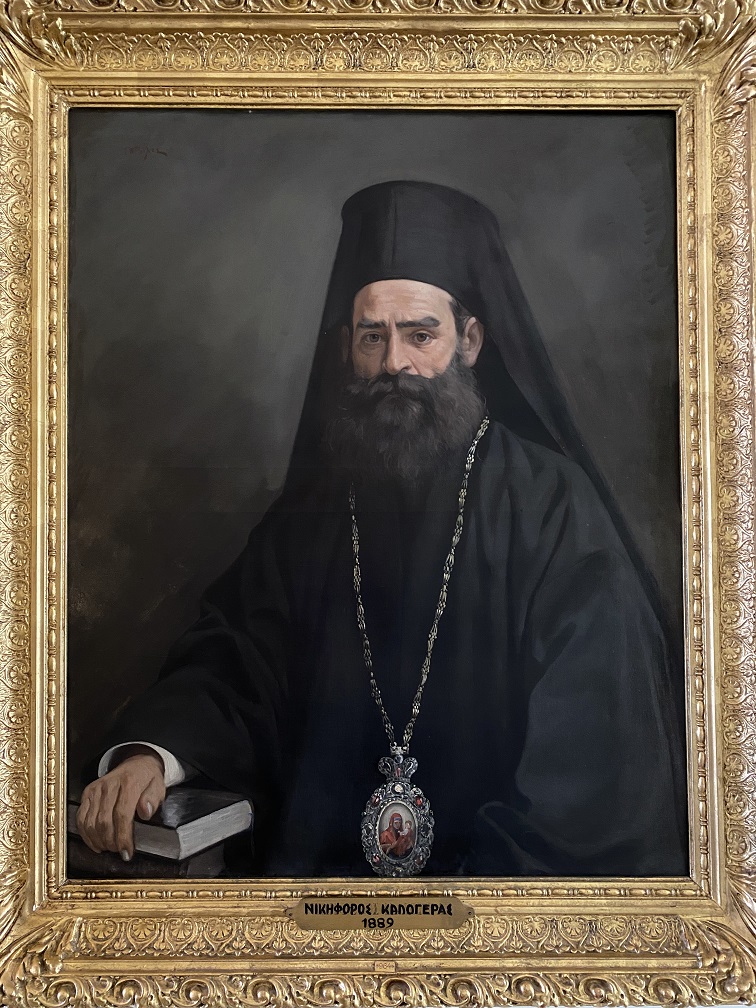
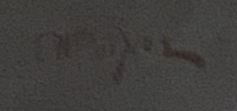
In the top left of the framed painting, you can see the signature of Γεώργιος Ροϊλός:
Painting from the Rizarios Ecclesiastical School
This portrait was painted by an unknown artist in 1895.
The painting is located in the hall with the works of art of the Rizarios Foundation at Βασιλίσσης Σοφίας 51, Athens, 106 76, Greece.
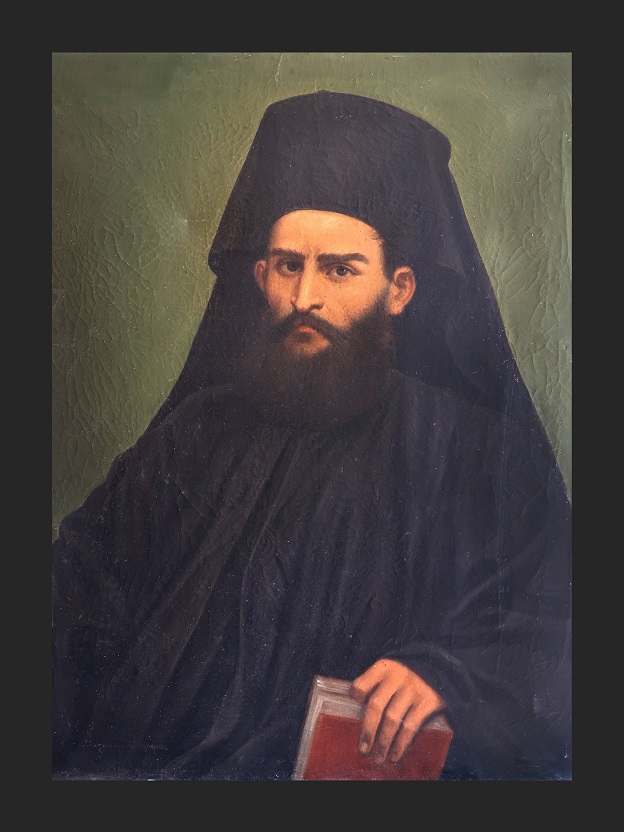
In the bottom left, you can see written the name Νικηφόρος Καλογεράς, identifying the subject of the painting:

Painting from the University of Athens
This portrait was painted by Βύρων Κοντόπουλος, but the year is unknown.
The painting is located in the Hall of Ceremonies (Αίθουσα Τελετών) at the University of Athens at Πανεπιστημίου 30, Athens 106 79, Greece.
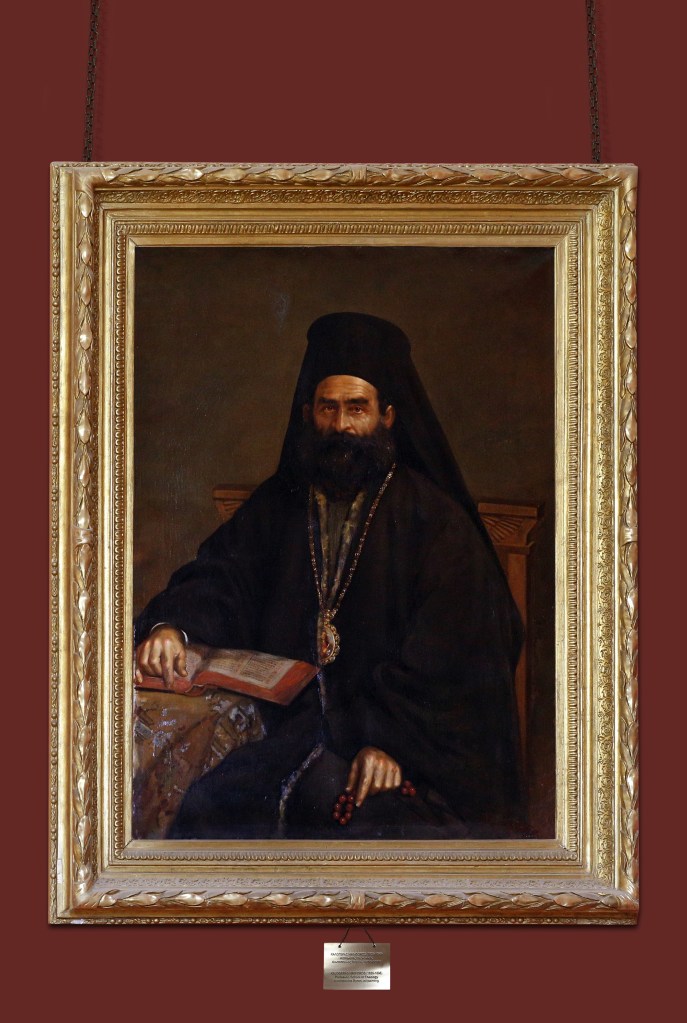
The plaque that identifies the painting in the Hall of Ceremonies reads:

 Zigabenus Epistles